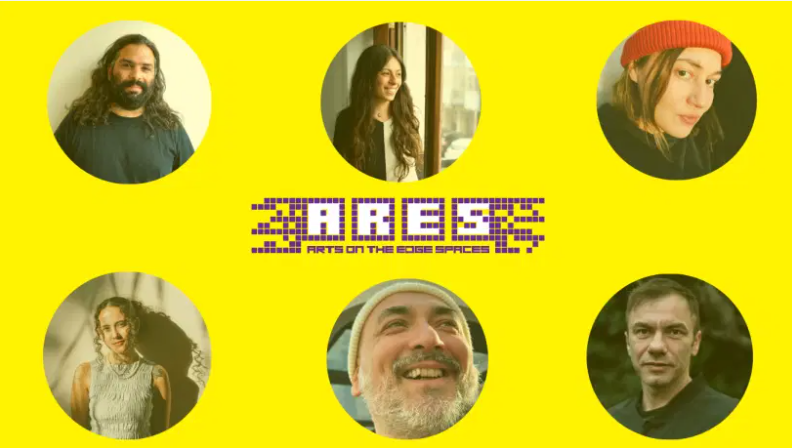
Arts on the Edge Spaces (ARES) Artist Announcement
Six artists have been selected to undertake residencies in Finland, Romania and Portugal for Arts on the Edge Spaces (ARES) – a two-year cooperation project initiated by WASP STUDIOS Bucharest together with HIAP Helsinki and SCIAENA Faro.
ARES will unfold in places often perceived as peripheral — geographically, politically or culturally. Coastal territories, delta regions and post-industrial urban contexts are proposed as working grounds for artistic research responding to climate pressure, shifting economies and geopolitical instability.
The project connects cultural organisations and artists working in communities situated at the geographic, social and symbolic edges of Europe. Rooted in cross-border collaboration and shared infrastructure, ARES develops sustainable models of mobility, research, co-creation and artistic circulation.
The open call received 142 applications and focussed on artists engaged with questions of climate, justice and society. Applicants were asked to demonstrate how they would approach working in the residency locations, including engaging with the communities who live and work there.
Each artist will respond to the themes of ARES and the location they are resident in. Find out more about the artists, their projects and the residency locations below.
Funded by the European Union. Views and opinions expressed are however those of the author(s) only and do not necessarily reflect those of the European Union or the European Education and Culture Executive Agency (EACEA). Neither the European Union nor EACEA can be held responsible for them.
About the artists
Cristian Vãduva (Romania) – Hosted by SCIAENA.
Cristian Văduva is a visual and multimedia artist, cinematographer and videographer based in Timișoara, Romania. His artistic practice focuses on moving image, space and the sensory experience of the viewer. He works through his own multimedia production studio, Kaze Media.
Since 2015, he has been creating visual experiences for concerts, musicians and festivals, exploring the relationship between image, sound and live performance. Since 2018, his practice has expanded into theatre, contemporary dance and performance art, where moving image becomes an integral part of the stage and storytelling process.
His work spans video and multimedia installations, documentary and short films, music videos, large-scale video projections and mapping, as well as photography and stop-motion animation. He is interested in the ways in which moving image can transform the perception of a space and create experiences that go beyond visual representation.
In recent years, his artistic research has focused on the relationship between image, space, memory and perception, developing projects in which film, sound, architecture and performance intersect within an interdisciplinary visual language. An important direction of his practice is the exploration of social and cultural realities through documentary and poetic forms, with a continued interest in themes such as identity, history, transformation and the relationship between humans and their environment.
One of his most significant recent projects is Crafting Transylvania, developed with a small teamn for the ASTRA Museum in Sibiu. Dedicated to traditional craftsmanship in wood, clay and textiles, the project included three video installations and a large-scale video mapping work, and received the iF Design Award 2025.
His work has been presented in cultural contexts in Romania and internationally, through collaborations with artists from music, theatre, contemporary dance and visual arts, as well as through film, photography and multimedia production. Across his practice, he explores ways of using technology not merely as a production tool, but as an integral part of the artistic language and the audience’s direct experience.
Enrique Eduardo Roura Perez (Mexico / Norway) – Hosted by WASP.
Enrique Roura (b. Mexico City, 1988) is a Norway-based artist working at the intersection of art and architecture. His practice approaches everyday and architectural forms as artefacts — material records of economic, cultural, and social conditions — through sculpture, installation, site-specific intervention, and sound. Informed by his experience of moving between Mexico and Norway, he reads environments as documents, asking what a place, object, or structure reveals about the forces that produced it.
Roura has exhibited in Norway and internationally, and his work is held in the collection of Trondheim Kunstmuseum, where Cántaro Exiliado — a sound installation in dialogue with pre-Columbian artefacts — remains on view until 2028. His practice has been shaped by residencies in geographically and politically charged territories: the Azores archipelago, where the Atlantic Ocean defines both connection and isolation; and the city of Narva placed in one border between the European Union and Russia. Recent projects include At a Point of No Convergence (BABEL, Trondheim, 2026) and Be the Ramp (ROM for Kunst og Arkitektur, Oslo, 2025). He lives and works in Oslo.
Jean-Lorin Sterian (Romania) – Hosted by HIAP.
Born 1975 in Constanta/Romania. Jean-Lorin Sterian is a researcher, writer, artist and performer currently based in Bucharest/Romania. He completed his bachelor’s degree in journalism at Spiru Haret University in Bucharest in 1998. He has a master in anthropology from the SNSPA (2009) and a master in “Society, Multimedia, Spectacle” (Center Of Excellence In Image Study, University of Bucharest, 2015). He holds a PhD in performance studies/sociology researching what he coined to be “homemade culture” – art events held in apartments. In 2008 Jean-Lorin Sterian opened lorgean theatre, the first living-room theater in Romania and since 2014 he manages HomeFest and lorgennale, an arts festival held only in houses and flats in different cities of Europe. Since 2018 he performs with his art musical-performative project, pj.lo & the accidentals. Jean-Lorin Sterian worked as a performer for two projects at Venice Biennale, The Sinthome Score (2015, Dora Garcia) and An Immaterial Retrospective of the Venice Biennale (2013, Pirici & Pelmus). He also performed his own independent art project, The parasite socks project, as a statement against the Venice Biennale (parallel to the 56th Venice Biennale). He created performance shows like We Need to Talk About lorgean (2014), Strip-tease (2013, with Alice Pons) and Zugzwang (2012). In 2016-2017 he was a fellow at Schloss Akademie Solitude. He published several fiction and poetry books.
Luísa Saraiva Leao Leite da Silva (Brazil / Portugal) – Hosted by HIAP.
Luísa Leão (Brasília, 1998) lives in Faro, where she has been an artist-in-residence at the GamaRama Gallery since 2024. She holds a PhD in Arts from the University of Beira Interior (2026), as well as a Bachelor’s and Master’s degree in Fashion Design from the same institution (2019; 2021), having undertaken academic exchanges at the Politecnico di Milano and the Federal University of Ceará. Her practice has its roots in the gestures of sewing and collage explored in childhood, now revisited in abstract and organic material-textile paintings and sculptures. She works with wool fibre in a processual and vertical manner, incorporating heirloom textiles into a political-affective investigation focused on experiences of temporality that elude the accelerated and fragmented logic of the contemporary world.
By inviting the body to inhabit other durations, she proposes a revival of sensory experience. As the minimal unit of continuity, the thread acts as a universal, ancestral and feminine element, interconnecting matter, body and earth in a process of subjective and dialogical recomposition. Within it lies the memory of stories that have survived through care, repetition and transmission. Having exhibited regularly since 2022, she was notably selected as a finalist in the National Exhibition of Young Creators (2025). Her practical research has been driven by artist residencies, such as ‘Alinhados pela Mesma Lã’ (Loulé Criativo, 2025) — which culminated in exhibitions at the National Society of Fine Arts (2026), the Gama Lobo Palace (2025) and the Madrid Design Festival (2026) —, the residency at the International Symposium on Contemporary Art at the Guarda Museum (2026) and the Textile Art Residency at Tekstiilikeskus in Estonia (2026). Her work is held in public and private collections.
Juliana Lee Pinto (Brazil / Portugal) – Hosted by WASP.
Julee (Juliana Lee Pinto, Curitiba, 1994) is a Brazilian visual artist based in Lisbon. Her practice investigates processes of material transformation and the ways in which objects, materials, and images can shift from their original contexts to acquire new meanings.
Working across sculpture, installation, and photography, she engages natural, domestic, and found materials, chosen both for their physical properties and the symbolic and cultural associations they carry. Her work follows different states of matter — decomposition, containment, transformation, and persistence — allowing time, chance, and the inherent behaviour of materials to participate in the formation of each piece. By isolating and reorganising elements associated with labour, domestic space, and everyday life, her work reveals underlying systems of value and power while opening space for symbolic and spiritual readings of the material world.
Currently pursuing an MA in Sculpture at the Faculty of Fine Arts, University of Lisbon, she holds a BA in Multimedia Art from the same institution and undertook further training at Ar.Co – Center for Art and Visual Communication and Casa Museu Alfredo Andersen. In 2025, she presented the solo exhibitions Fluxo Contínuo (Cooperativa Artística Árvore, Porto) and À Margem (Casa do Jardim da Estrela, Lisbon). In 2026, she was awarded the Ponto Kultural Artistic Creation Grant. Since 2021, she has also developed workshops and participatory projects as an extension of her artistic practice.
Polina Choni (Ukraine) – Hosted by SCIAENA.
Polina Choni is a Ukrainian visual artist working across installation, moving image, and field research. Her work often begins with things that are difficult to see: what disappears underground, returns for a short season, accumulates in soil, or remains after a visible event has ended.
Through repeated observation and material experimentation, she follows how landscapes hold traces — in soil, seasonal absence, and matter that outlasts the event that changed it. She works between field and studio, returning to places, materials, and processes over time, often to see what only becomes perceptible at another scale or after longer attention. For Choni, landscape is never quite a fixed image, but something continually forming, disappearing, and becoming visible again.
Choni received a one-year working grant from Kone Foundation, and her practice has developed through residencies including HIAP and Serlachius. Recent work includes Underground Forest, a stop-motion project based on field research in the Tarutynskyi steppe.
About the locations
Romania: WASP closely collaborates with national partners hosting residencies in the Danube Delta, at The Ivan Patzaichin Museum – Community Innovation Center in Mila 23, Atelier Saraev in Sulina and at NOD Makerspace, along Dâmbovița River in Bucharest.
Portugal: One of the most striking coastline landscapes in the Algarve is Ria Formosa, a protected region of exceptional ecological significance. Stretching along the eastern Algarve coast between Faro, Olhão, Tavira, and Vila Real de Santo António, Ria Formosa is a dynamic area of barrier islands, tidal channels, salt marshes, salt pans, lagoons, and beaches where natural ecosystems collide with activities and ways of life that are closely linked to the sea
Finland: Suomenlinna island. A UNESCO World Heritage Site, Suomenlinna is home to 800 permanent residents, 400 workers, an open prison, an active military base and is visited by over 1 million tourists annually. The island has a diverse and important history in the context of Finland and the broader Nordic Baltic region’s past. You can find out more about Suomenlinna’s history here.
About the partners
WASP Working Art Space and Production is a cultural organisation which develops strategic national and international partnerships to support the production and promotion of contemporary visual and performing arts, organises and hosts residencies, workshops, debates, productions and presentations. Established in 2012, WASP has developed its activity as a community center for arts and culture in Bucharest, activating the important role of dialogue and inclusion, education and audience development. Since 2017, WASP has developed cross-disciplinary international projects, between art, architecture and ecology, including multidisciplinary creations and itinerary exhibitions in Europe.
Sciaena is a Portuguese environmental NGO that works at the intersection of creative expression, community involvement, and marine science. Founded in 2006, it runs from local projects with fishing villages and schools to national and international advocacy addressing important ocean-related issues. It envisions a healthy ocean supported by an informed and empowered people.
Believing in the transformative power of the arts to translate scientific knowledge into shared cultural experiences, Sciaena uses artistic expression as a bridge between research, emotion and public action. In 2014, it created Mar Motto, an annual ocean-focused arts festival that brings together contemporary art, debates, music, performances and workshops in a temporary exhibition space. Expanding this dialogue between science, culture and environmental awareness, Sciaena also launched Scianema in 2016, an annual environmental film festival showcasing documentaries that explore the fragile relationship between humanity and the marine environment.
HIAP Helsinki International Artist Programme has delivered residencies for international artists since 1998, and is the largest artist residency platform in the Nordic Baltic region. We work across two locations in Helsinki – Cable Factory, a multi-arts centre on Helsinki mainland, and Suomenlinna, a UNESCO world heritage site and island located approximately 15 minutes by boat from Helsinki’s Kauppatori. Annually, we welcome up to 75 artists across both sites, to undertake residencies. HIAP also programmes Gallery Augusta, located on Suomenlinna, which is an exhibition platform for international and Finland based artists, and coordinates FAIRE, the Finnish Artist Residency Network. Projects include Ukraine Solidarity Residencies Programme, Learning Materials and multiple international exchanges.