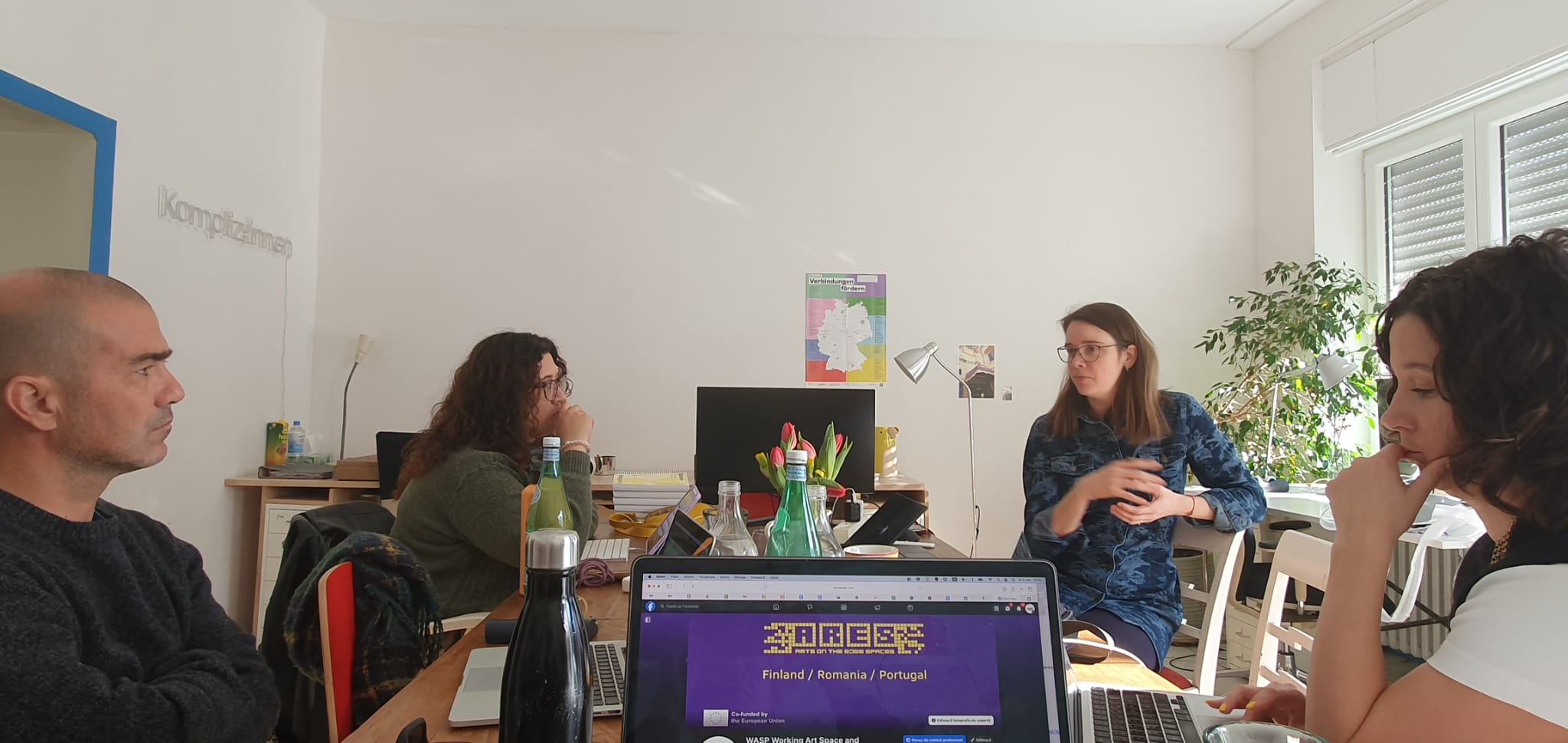
Arts on the Edge Spaces (ARES) Kick-off Meeting
How can cultural organisations make their work greener, more inclusive and better equipped to respond to environmental and social challenges?
The ARES management workshop brought together in March 2026 the international partners WASP Bucharest, SCIAENA Faro, and HIAP Helsinki hosted by Kompliz:innen in Düsseldorf for three days of strategic planning, exchange and peer learning, focusing on how shared expertise can inform everyday cultural management and strengthen cross-border collaboration.
Arts on the Edge Spaces (ARES) is a two-year cooperation project initiated by WASP Bucharest – Working Art Space and Production together with partner organisations HIAP – Helsinki International Artist Programme and SCIAENA Faro and Nedelcu & Hauser as associated partner.
ARES unfolds in places often perceived as peripheral — geographically, politically or culturally. Coastal territories, delta regions and post-industrial urban contexts are proposed as working grounds for artistic research responding to climate pressure, shifting economies and geopolitical instability. The project connects cultural organisations and artists working in communities situated at the geographic, social and symbolic edges of Europe. Rooted in cross-border collaboration and shared infrastructure, ARES develops sustainable models of mobility, research, co-creation and artistic circulation.
Part I — Key topics and expert insights
Green practices through shared experience
ARES builds on the management experience and ecological expertise of its partners to connect artistic practice with local environmental and social challenges. Its approach combines ecological reflection with artistic solidarity, recognising artists as facilitators of local ecological and social resilience and highlighting the importance of stable support systems for artists and communities.
HIAP’s Post-Fossil Transition initiative, developed in collaboration with Mustarinda, offers a practical model for embedding ecological responsibility in the everyday operations of an arts organisation. By focusing on travel, food and energy, it demonstrates how climate ambitions can translate into institutional changes, while challenging cultural organisations to rethink established ways of working. WASP’s Emerging Towards (Future), supported by the RO-CULTURA Programme, explores the relationship between art, architecture and ecology through intergenerational and cross-sectoral collaboration, research, production and public engagement. A further reference is The Big Green, a European collaboration exploring how art can advance sustainability and how cultural organisations can reduce their ecological footprint, where SCIAENA is a partner organisation. Through its annual ocean-focused arts festival, Mar Motto brings this work into dialogue with SCIAENA’s expertise in environmental awareness and the challenges facing marine ecosystems and society.
These experiences formed the basis for the workshop’s internal knowledge exchange. Andreea Căpitănescu, Artistic Director of WASP; Emma Beverley, Director of HIAP; Vasco Guia de Abreu, Executive Co-Director of SCIAENA; and Joana Coelho, Communication and Events Coordinator at SCIAENA, shared practices from their organisations’ projects and examples from other inspiring institutions, organisations and networks. Discussions addressed how to integrate ecological measures into artistic projects, strengthen sustainable cultural management and translate shared ambitions into practical working methods.
Management structures that support collaboration
International artistic projects require clear responsibilities, realistic timelines and working methods that accommodate different local conditions. During the exchange, partners reviewed upcoming activities and exhibition production, including the challenges posed by international mobility between the edges of the continent.
The consortium identified the need for more flexible schedules and a shared exhibition protocol to support production workflows across partner organisations. The Project Management Manual and Communication Guideline will provide a common framework for coordination, reporting and decision-making.
These tools are intended to make collaboration more effective while protecting the time and conditions needed for artistic work. Clear agreements, shared documentation and contingency planning help partners anticipate challenges, coordinate resources and respond to changing circumstances.
Inclusion and working with communities
ARES recognises edge positions as sources of knowledge, creativity and new perspectives. Meaningful engagement therefore requires attention to who participates, whose experiences shape a project and what barriers may limit access.
The partners discussed transparent artist selection, inclusive communication and safer working environments. A common evaluation framework considers artistic excellence, thematic relevance, community engagement, ecological awareness and feasibility. ARES also draws on HIAP’s Safer Spaces Policy and Code of Conduct as resources for inclusive collaboration.
A capacity-building session with Caspar Weimann from the artistic collective onlinetheater.live explored digital communities and right-wing extremism, connecting cultural work with wider questions of participation and political polarisation. Exhibition visits to Land and Soil. How We Live Together at Kunstsammlung Nordrhein-Westfalen and restraumraumrest at Kunst im Tunnel, with an exchange involving curator and project manager Jessica Aydin and artist Miriam Bornewasser, further connected management discussions with artistic and curatorial practice.
Together, these discussions and encounters reflected ARES’s commitment to supporting artists and communities as active contributors to ecological and social change, and to creating the conditions for artistic responses to emerge from local knowledge and experience.
Part II — Recommendations for Cultural Managers
- Build on existing expertise: Exchange knowledge across partner organisations and adapt proven practices to different local contexts.
- Integrate ecological thinking: Embed environmental responsibility in artistic decisions, production processes and everyday project management.
- Create sustainable working conditions: Establish clear responsibilities, realistic timelines and contingency plans that support artistic research and collaboration.
- Make inclusion part of project management: Apply transparent selection criteria, accessible communication, fair working conditions and shared codes of conduct.
- Strengthen local connections: Engage artists, experts and communities as contributors to knowledge production, ecological resilience and social change.
- Learn and adapt collectively: Document experiences, evaluate practices and use shared tools to improve future projects and cross-border cooperation.
Funded by the European Union. Views and opinions expressed are however those of the author(s) only and do not necessarily reflect those of the European Union or European Education and Culture Executive Agency (EACEA). Neither the European Union nor the granting authority can be held responsible for them.